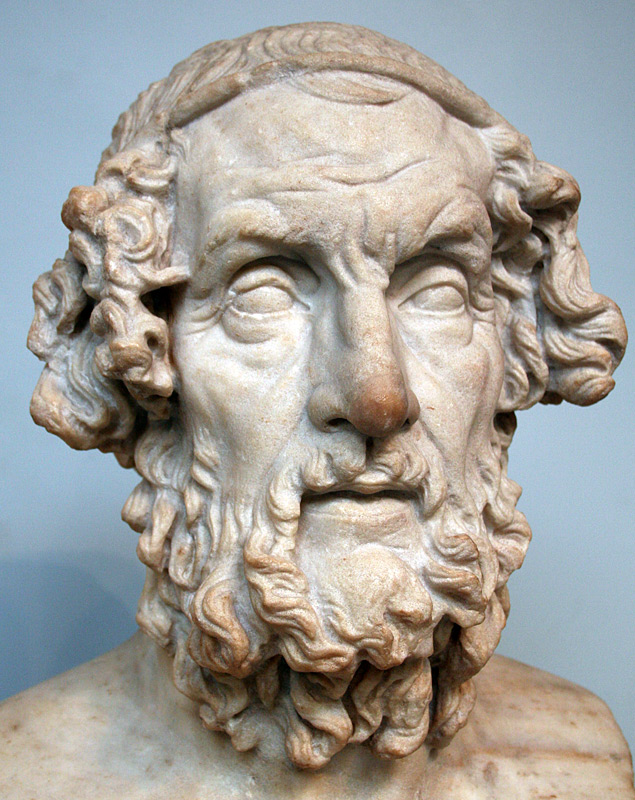
Homér najznámejšie citáty


Homér citáty a výroky
„Veľa hovoriť a veľa povedať nie je to isté.“
Varianta: Veľa hovoriť a veľa povedať, nieje to isté.

„Nie je na svete nič slabšieho než muž.“
Prisudzované výroky
Varianta: Na svete niet nič slabšie ako muž.
Homér: Citáty v angličtine
Homér Iliad
Varianta: Any moment might be our last. Everything is more beautiful because we're doomed. You will never be lovelier than you are now. We will never be here again.
Zdroj: The Iliad
Homér The Odyssey (Cowper)
Zdroj: The Odyssey
Homér Iliad
XVIII. 130–131 (tr. Robert Fagles). Cf. Iliad, XVII. 446–447.
Samuel Butler's translation:
: Man is the vainest of all creatures that have their being upon earth.
Robert Fitzgerald's translation:
: Of mortal creatures, all that breathe and move,
earth bears none frailer than mankind.
Odyssey (c. 725 BC)
Varianta: Of all creatures that breathe and move upon the earth, nothing is bred that is weaker than man.
Zdroj: The Iliad
Homér Iliad
VI. 488–489 (tr. Robert Fagles).
Iliad (c. 750 BC)
Homér Iliad
VI. 484 (tr. Lord Derby); of Andromache.
Iliad (c. 750 BC)
“Men grow tired of sleep, love, singing and dancing, sooner than of war.”
Homér Iliad
A misquotation http://listserv.linguistlist.org/pipermail/ads-l/2009-August/092648.html of:<br><br>Πάντων μὲν κόρος ἐστὶ καὶ ὕπνου καὶ φιλότητος<br>μολπῆς τε γλυκερῆς καὶ ἀμύμονος ὀρχηθμοῖο,<br>τῶν πέρ τις καὶ μᾶλλον ἐέλδεται ἐξ ἔρον εἷναι<br>ἢ πολέμου· Τρῶες δὲ μάχης ἀκόρητοι ἔασιν.<br><br>Men get<br>Their fill of all things, of sleep and love, sweet song<br>And flawless dancing, and most men like these things<br>Much better than war. Only Trojans are always<br>Thirsty for blood!<br><br>Iliad, XIII, 636–639 (tr. Ennis Rees)<br><br>The misquotation implies that an overweening love of war was the norm, whereas the real quote decries the Trojans as inhumane for keeping the war going. <br class="br">Misattributed
“Few sons, indeed, are like their fathers.
Generally they are worse; but just a few are better.”
Homér The Odyssey (Cowper)
II. 276–277 (tr. E. V. Rieu).
Odyssey (c. 725 BC)
Zdroj: The Odyssey
“Some of the words you'll find within yourself,
the rest some power will inspire you to say.”
Homér The Odyssey (Cowper)
III. 26–27 (tr. Robert Fagles); Athena to Telemachus.
Odyssey (c. 725 BC)
“Now always be the best, my boy, the bravest,
and hold your head up high above the others.”
Homér Iliad
VI. 208 (tr. Robert Fagles).
Iliad (c. 750 BC)
“Nevertheless I long—I pine, all my days—
to travel home and see the dawn of my return.”
Homér The Odyssey (Cowper)
V. 219–220 (tr. Robert Fagles).
Odyssey (c. 725 BC)
Homér Iliad
XIV. 216–217 (tr. Robert Fagles).
Alexander Pope's translation:
: In this was every art, and every charm,
To win the wisest, and the coldest warm:
Fond love, the gentle vow, the gay desire,
The kind deceit, the still reviving fire,
Persuasive speech, and more persuasive sighs,
Silence that spoke, and eloquence of eyes.
Iliad (c. 750 BC)
Zdroj: The Iliad
“Who dares think one thing, and another tell,
My heart detests him as the gates of hell.”
Homér Iliad
IX. 312–313 (tr. Alexander Pope).
A. H. Chase and W. G. Perry, Jr.'s translation:
: Hateful to me as the gates of Hades is the man who hides one thing in his heart and speaks another.
Iliad (c. 750 BC)
Zdroj: The Iliad
“For a friend with an understanding heart is worth no less than a brother.”
Homér The Odyssey (Cowper)
VIII. 585–586 (tr. G. H. Palmer).
Odyssey (c. 725 BC)
Zdroj: The Odyssey
“By hook or by crook this peril too shall be something that we remember”
Homér The Odyssey (Cowper)
Zdroj: The Odyssey
“But Zeus does not bring to accomplishment all thoughts in men's minds.”
Homér Iliad
XVIII. 328 (tr. R. Lattimore).
Iliad (c. 750 BC)
Homér Iliad
XV. 563–564 (tr. Alexander Pope).
Iliad (c. 750 BC)
“And some day let them say of him:
'He is better by far than his father.”
Homér Iliad
VI. 479 (tr. R. Lattimore).
Iliad (c. 750 BC)


