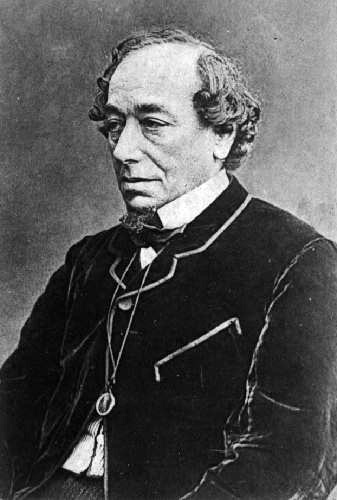
Benjamin Disraeli najznámejšie citáty
Benjamin Disraeli Citáty o láske
Potvrdené výroky
Zdroj: MÜHS, Wilhelm: Slovom srdca, 365 myšlienok o láske. Bratislava: Nové mesto, 2000, s. 200. ISBN 80-85487-61-6
Benjamin Disraeli citáty a výroky
Benjamin Disraeli: Citáty v angličtine
Zdroj: Speech on Reform Bill of 1867, Edinburgh, Scotland (29 October 1867); quoted in William Flavelle Monypenny and George Earle Buckle, The Life of Benjamin Disraeli, Earl of Beaconsfield. Volume II. 1860–1881 (London: John Murray, 1929), p. 291.
“I don't wish to go down to posterity talking bad grammar.”
Correcting the Hansard proofs of his last speech to Parliament (31 March 1881), shortly before his death, cited in Harper's, Vol. 63 (1881). The quote is given in William Flavelle Monypenny and George Earle Buckle, The Life of Benjamin Disraeli, Earl of Beaconsfield, Vol. 1 (1929) as "I will not go down to posterity talking bad grammar".
1880s
Speech http://hansard.millbanksystems.com/commons/1845/apr/11/maynooth-college in the House of Commons (11 April 1845). <br class="br">1840s
Speech in the House of Commons (24 April 1844), referring to Lord Stanley; compare: "The brilliant chief, irregularly great, / Frank, haughty, rash,—the Rupert of debate!", Edward Bulwer-Lytton, The New Timon (1846), Part i.
1840s
Book VIII, Chapter 4.
Books, Coningsby (1844), Vivian Grey (1826)
“Every production of genius must be the production of enthusiasm.”
Isaac D'Israeli, The Curiosities of Literature, "Solitude".
Misattributed, Isaac D'Israeli
Cited in William Flavelle Monypenny and George Earle Buckle, The life of Benjamin Disraeli, Rarl of Beaconsfield, Vol. 6 (1920), p. 463, and in Henry W. Lucy, Memories of Eight Parliaments (1908), p. 66.
Sourced but undated
Speech http://hansard.millbanksystems.com/commons/1846/may/15/corn-importation-bill-adjourned-debate in the House of Commons (15 May 1846). <br class="br">1840s
“The art of governing mankind by deceiving them.”
Isaac D'Israeli's Curiosities of Literature has, "Between solid lying and disguised truth there is a difference known to writers skilled in 'the art of governing mankind by deceiving them'; as politics, ill understood, have been defined".
Misattributed, Isaac D'Israeli
Shropshire Conservative (31 August 1844), quoted in William Flavelle Monypenny and George Earle Buckle, The Life of Benjamin Disraeli, Earl of Beaconsfield. Volume I. 1804–1859 (London: John Murray, 1929), p. 629.
1840s
Zdroj: Speech to the Conservatives of Manchester (3 April 1872), quoted in William Flavelle Monypenny and George Earle Buckle, The Life of Benjamin Disraeli, Earl of Beaconsfield. Volume II. 1860;1881 (London: John Murray, 1929), p. 529.
“Variety is the mother of Enjoyment.”
Book V, Chapter 4.
Books, Coningsby (1844), Vivian Grey (1826)
“Patience is a necessary ingredient of genius.”
Part 4, Chapter 5.
Books, Coningsby (1844), Contarini Fleming (1832)
Zdroj: Letter to Lady Chesterfield (22 December 1880), quoted in the Marquis of Zetland (ed.), The Letters of Disraeli to Lady Bradford and Lady Chesterfield. Vol. II, 1876 to 1881 (London: Ernest Benn Limited, 1929), pp. 304-305.
Book VI, Chapter 7.
Books, Coningsby (1844), Vivian Grey (1826)
Speech at the Printing Trade Festival (1845).
1840s
“It destroys one's nerves to be amiable every day to the same human being.”
Book III, Chapter 2.
Books, Coningsby (1844), The Young Duke (1831)
“Plagiarists, at least, have the merit of preservation.”
Isaac D'Isaeli, Curiosities of Literature, "Of Suppressors and Dilapidators of Manuscripts".
Misattributed, Isaac D'Israeli
Speech http://hansard.millbanksystems.com/commons/1846/feb/20/commercial-policy-customs-corn-laws in the House of Commons (20 February 1846). <br class="br">1840s
“Diligence is the mother of good fortune.”
Zdroj: Don Quixote de la Mancha (1605–1615), Part II (1615), Book III, Ch. 43.
Addressing the House of Commons after the assassination of Abraham Lincoln (1 May 1865)
1860s
Speech https://api.parliament.uk/historic-hansard/commons/1876/mar/09/second-reading-1 in the House of Commons (9 March 1876) on the Royal Titles Act that bestowed on Queen Victoria the title "Empress of India". <br class="br">1870s
Zdroj: Speech in the House of Lords (29 April 1879), reported in The Times (30 April 1879), p. 8.
Book III, Chapter 9.
Books, Coningsby (1844), Vivian Grey (1826)
“The microcosm of a public school.”
Book I, Chapter 2.
Books, Coningsby (1844), Vivian Grey (1826)
“Duty cannot exist without faith.”
Bk. II, Ch. 1.
Books, Coningsby (1844), Tancred (1847)
Attacking William Gladstone's Liberal Government
Zdroj: Speech to the Conservatives of Manchester (3 April 1872), quoted in William Flavelle Monypenny and George Earle Buckle, The Life of Benjamin Disraeli, Earl of Beaconsfield. Volume II. 1860–1881 (London: John Murray, 1929), pp. 530-531.
“What we anticipate seldom occurs; what we least expected generally happens.”
Book 2, chapter 4. Compare: "I say the very things that make the greatest Stir / An' the most interestin' things, are things that did n't occur", Sam Walter Foss, Things that did n't occur.
Books, Coningsby (1844), Henrietta Temple (1837)


