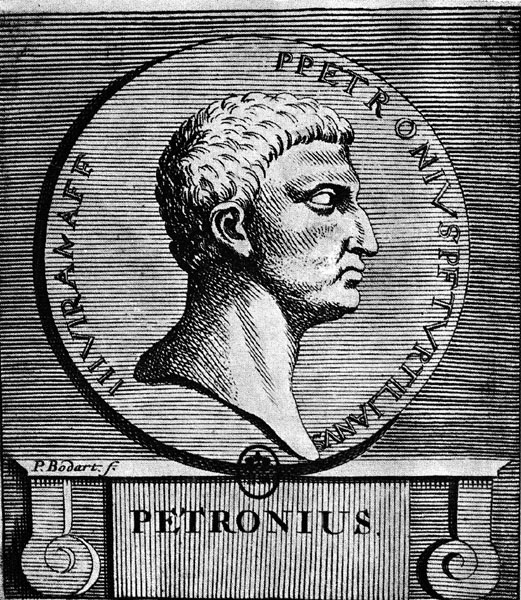
Gaius Titus Petronius najznámejšie citáty
Gaius Titus Petronius Citáty o ľuďoch
Gaius Titus Petronius citáty a výroky
„Čokoľvek sa učíš, učíš sa pre seba.“
Prisudzované výroky
Zdroj: [LENČOVÁ, Žofia.: Perly antiky. Ostrava: Knižní expres, 1997 ISBN 80-902272-7-9]
„Len málokedy sa spája krása s múdrosťou.“
Prisudzované výroky
Zdroj: [LENČOVÁ, Žofia.: Perly antiky. Ostrava: Knižní expres, 1997 ISBN 80-902272-7-9]
„Čo by zmohli zákony tam, kde vládnu jedine peniaze?“
Varianta: Načo sú zákony tam, kde jedine peniaze vládnu.
„Každý, kto má peniaze, pláva s priaznivým vetrom.“
Varianta: Kto má peniaze, pláva s priaznivým vetrom.
Gaius Titus Petronius: Citáty v angličtine
“He has joined the great majority.”
Abiit ad plures.
Petronius kniha Satyricon
Sec. 42
Variant translations:
He’s gone to join the majority [the dead].
He has gone to the majority.
(i.e. He has died.)
Satyricon
“A huge dog, tied by a chain, was painted on the wall and over it was written in capital letters ‘Beware of the dog.”
Canis ingens, catena vinctus, in pariete erat pictus superque quadrata littera scriptum ‘Cave canem.’
Petronius kniha Satyricon
Sec. 29
Satyricon
A paraphrased quotation from Charlton Ogburn (1911–1998) in "Merrill's Marauders: The truth about an incredible adventure" http://www.harpers.org/archive/1957/01/0007289 in the January 1957 issue of Harper's Magazine <br class="br">Actual Charlton Ogburn quote: "We trained hard, but it seemed that every time we were beginning to form up into teams we would be reorganized. Presumably the plans for our employment were being changed. I was to learn later in life that, perhaps because we are so good at organizing, we tend as a nation to meet any new situation by reorganizing; and a wonderful method it can be for creating the illusion of progress while producing confusion, inefficiency and demoralization." <br class="br">Misattributed
Petronius kniha Satyricon
she replied, 'I want to die."
Sec. 48
In the T. S. Eliot poem, "The Waste Land", Petronius' original Latin and Greek is quoted: Nam Sibyllam quidem Cumis ego ipse oculis meis vidi in ampulla pendere, et cum illi pueri dicerent: Σίβυλλα τί θέλεις; respondebat illa: ἀποθανεῖν θέλω. The translation generally associated with Eliot's poem is as follows: For with my own eyes I saw the Sibyl hanging in a bottle, and when the young boys asked her, 'Sibyl, what do you want?', she replied, 'I want to die' .
The quote refers to the mythic Cumaean Sibyl who bargained with Apollo, offering her virginity for years of life totaling as many grains of sand as she could hold in her hand. However, after she spurned his love, he allowed her to wither away over the span of her near-immortality, as she forgot to ask for eternal youth.
Satyricon
“A man who is always ready to believe what is told him will never do well.”
Petronius kniha Satyricon
Sec. 43
Satyricon


