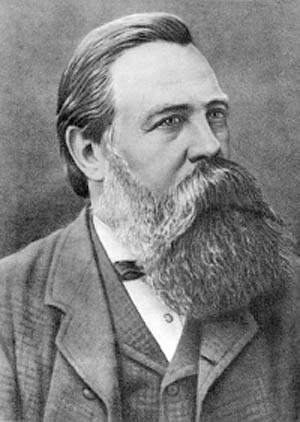
Friedrich Engels najznámejšie citáty
Friedrich Engels: Citáty v angličtine
Zdroj: (1845), p. 112
“Comedy is in act superior to tragedy and humourous reasoning superior to grandiloquent reasoning.”
Attributed by Karl Marx in Comments on the North American Events http://hiaw.org/defcon6/works/1862/10/12.html, Die Presse (12 October 1862)
(1847)
(1847)
(1847)
Nachdem die liberale Ökonomie ihr Bestes getan hatte, um durch die Auflösung der Nationalitäten die Feindschaft zu verallgemeinern, die Menschheit in eine Horde reißender Tiere - und was sind Konkurrenten anders?
zu verwandeln, die einander ebendeshalb auffressen, WEIL jeder mit allen andern gleiches Interesse hat, nach dieser Vorarbeit blieb ihr nur noch ein Schritt zum Ziele übrig, die Auflösung der Familie. Um diese durchzusetzen, kam ihr eine eigene schöne Erfindung, das Fabriksystem, zu Hülfe.
Outlines of a Critique of Political Economy (1844)
Friedrich Engels The Part Played by Labour in the Transition from Ape to Man
The Part Played by Labour in the Transition from Ape to Man (1876) http://www.marxists.org/archive/marx/works/subject/quotes/index.htm
(1847)
Letter to Jean-Richard Bloch http://www.marxists.org/archive/marx/works/1890/letters/90_09_21.htm (September 21, 1890)
Letter to Philipp Van Patten http://www.marxists.org/archive/marx/works/1883/letters/83_04_18.htm (18 April 1883)
The Magyar Struggle http://www.marxistsfr.org/archive/marx/works/1849/01/13.htm in ' (13 January 1849).
Referring to the Serb uprising of 1848–49, in which Serbs from Vojvodina fought against the previously victorious Hungarian revolution. <br class="br">Zdroj: The Magyar Struggle http://www.marxistsfr.org/archive/marx/works/1849/01/13.htm in ' (13 January 1849).
Letter to Karl Marx http://www.marxists.org/archive/marx/works/1869/letters/69_12_09.htm (December 9, 1869)
Friedrich Engels kniha Anti-Dühring
Anti-Dühring, pt. 1, ch. 11 (1878)
Friedrich Engels kniha Principles of Communism
Principles of Communism (1847)
Ludwig Feuerbach and the End of Classical German Philosophy http://marxists.org/archive/marx/works/1886/ludwig-feuerbach/ch04.htm (1886)
Zdroj: The Condition of the Working Class in England in 1844 (1845), p. 112
Ihr habt die kleinen Monopole vernichtet, um das EINE große Grundmonopol, das Eigentum, desto freier und schrankenloser wirken zu lassen; ihr habt die Enden der Erde zivilisiert, um neues Terrain für die Entfaltung eurer niedrigen Habsucht zu gewinnen, ihr habt die Völker verbrüdert, aber zu einer Brüderschaft von Dieben.
Outlines of a Critique of Political Economy (1844)
(1847)
It dies out.
Socialism, Utopian and Scientific (1901)
(1847)
Draft of a Communist Confession of Faith http://www.marxists.org/archive/marx/works/1847/06/09.htm (1847)
(1847)
Der ganze Unterschied gegen die alte, offenherzige Sklaverei ist nur der, dass der heutige Arbeiter frei zu sein scheint, weil er nicht auf einmal verkauft wird, sondern stückweise, pro Tag, pro Woche, pro Jahr, und weil nicht ein Eigenthümer ihn dem andern verkauft, sondern er sich selbst auf diese Weise verkaufen muss, da er ja nicht der Sklave eines Einzelnen, sondern der ganzen besitzenden Klasse ist.
Zdroj: (1845), pp. 114-115
(1847)


