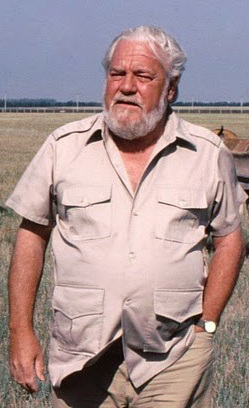
Gerald Durrell citáty a výroky
Gerald Durrell: Citáty v angličtine
“The attitude of the average person to the world they live in is completely selfish.”
Two in the Bush (1966)
Kontext: The attitude of the average person to the world they live in is completely selfish. When I take people round to see my animals, one of the first questions they ask (unless the animal is cute and appealing) is, "what use is it?" by which they mean, "what use is it to them?" To this one can reply "What use is the Acropolis?" Does a creature have to be of direct material use to mankind in order to exist? By and large, by asking the question "what use is it?" you are asking the animal to justify its existence without having justified your own.
Two in the Bush (1966)
Kontext: We have inherited an incredibly beautiful and complex garden, but the trouble is that we have been appallingly bad gardeners. We have not bothered to acquaint ourselves with the simplest principles of gardening. By neglecting our garden, we are storing up for ourselves, in the not very distant future, a world catastrophe as bad as any atomic war, and we are doing it with all the bland complacency of an idiot child chopping up a Rembrandt with a pair of scissors. We go on, year after year, all over the world, creating dust bowls and erosion, cutting down forests and overgrazing our grasslands, polluting one of our most vital commodities — water — with industrial filth and all the time we are breeding with the ferocity of the Brown Rat, and wondering why there is not enough food to go round. We now stand so aloof from nature that we think we are God. This has always been a dangerous supposition.
As quoted in Durrell: The Authorised Biography (1999) http://books.google.com/books?id=iyRFAAAAYAAJ&q=&quot;Look+at+it+this+way+Anyone+who+has+got+any+pleasure+at+all+from+living+should+try+to+put+something+back+life+is+like+a+superlative+meal+and+the+world+is+the+maitre+d'hotel+What+I+am+doing+is+the+equivalent+of+leaving+a+reasonable+tip&quot;Gerald by Douglas Botting <br class="br">Kontext: A sparrow can be as interesting as a bird of paradise, the behaviour of a mouse as interesting as that of a tiger. Our planet is beautifully intricate, brimming over with enigmas to be solved and riddles to be unravelled. <br>Many people think that conservation is just about saving fluffy animals – what they don’t realise is that we’re trying to prevent the human race from committing suicide … We have declared war on the biological world, the world that supports us … At the moment the human race is in the position of a man sawing off the tree branch he is sitting on.<br>Look at it this way. Anyone who has got any pleasure at all from living should try to put something back. Life is like a superlative meal and the world is the maître d'hôtel. What I am doing is the equivalent of leaving a reasonable tip. … I'm glad to be giving something back because I've been so extraordinarily lucky and had such great pleasure from it.
As quoted in Durrell: The Authorised Biography (1999) http://books.google.com/books?id=iyRFAAAAYAAJ&q=&quot;Look+at+it+this+way+Anyone+who+has+got+any+pleasure+at+all+from+living+should+try+to+put+something+back+life+is+like+a+superlative+meal+and+the+world+is+the+maitre+d'hotel+What+I+am+doing+is+the+equivalent+of+leaving+a+reasonable+tip&quot;Gerald by Douglas Botting <br class="br">Kontext: A sparrow can be as interesting as a bird of paradise, the behaviour of a mouse as interesting as that of a tiger. Our planet is beautifully intricate, brimming over with enigmas to be solved and riddles to be unravelled. <br>Many people think that conservation is just about saving fluffy animals – what they don’t realise is that we’re trying to prevent the human race from committing suicide … We have declared war on the biological world, the world that supports us … At the moment the human race is in the position of a man sawing off the tree branch he is sitting on.<br>Look at it this way. Anyone who has got any pleasure at all from living should try to put something back. Life is like a superlative meal and the world is the maître d'hôtel. What I am doing is the equivalent of leaving a reasonable tip. … I'm glad to be giving something back because I've been so extraordinarily lucky and had such great pleasure from it.
Two in the Bush (1966)
Kontext: We have inherited an incredibly beautiful and complex garden, but the trouble is that we have been appallingly bad gardeners. We have not bothered to acquaint ourselves with the simplest principles of gardening. By neglecting our garden, we are storing up for ourselves, in the not very distant future, a world catastrophe as bad as any atomic war, and we are doing it with all the bland complacency of an idiot child chopping up a Rembrandt with a pair of scissors. We go on, year after year, all over the world, creating dust bowls and erosion, cutting down forests and overgrazing our grasslands, polluting one of our most vital commodities — water — with industrial filth and all the time we are breeding with the ferocity of the Brown Rat, and wondering why there is not enough food to go round. We now stand so aloof from nature that we think we are God. This has always been a dangerous supposition.
Letter to his fiancée Lee, (31 July 1978), published in Gerald Durrell: An Authorized Biography by Douglas Botting (1999)
Kontext: I have seen a thousand sunsets and sunrises, on land where it floods forest and mountains with honey coloured light, at sea where it rises and sets like a blood orange in a multicoloured nest of cloud, slipping in and out of the vast ocean. I have seen a thousand moons: harvest moons like gold coins, winter moons as white as ice chips, new moons like baby swans’ feathers.
I have seen seas as smooth as if painted, coloured like shot silk or blue as a kingfisher or transparent as glass or black and crumpled with foam, moving ponderously and murderously. … I have known silence: the cold earthy silence at the bottom of a newly dug well; the implacable stony silence of a deep cave; the hot, drugged midday silence when everything is hypnotised and stilled into silence by the eye of the sun; the silence when great music ends.
I have heard summer cicadas cry so that the sound seems stitched into your bones. … I have seen hummingbirds flashing like opals round a tree of scarlet blooms, humming like a top. I have seen flying fish, skittering like quicksilver across the blue waves, drawing silver lines on the surface with their tails. I have seen Spoonbills fling home to roost like a scarlet banner across the sky. I have seen Whales, black as tar, cushioned on a cornflower blue sea, creating a Versailles of fountain with their breath. I have watched butterflies emerge and sit, trembling, while the sun irons their winds smooth. I have watched Tigers, like flames, mating in the long grass. I have been dive-bombed by an angry Raven, black and glossy as the Devil’s hoof. I have lain in water warm as milk, soft as silk, while around me played a host of Dolphins. I have met a thousand animals and seen a thousand wonderful things… but —
All this I did without you. This was my loss.
All this I want to do with you. This will be my gain.
All this I would gladly have forgone for the sake of one minute of your company, for your laugh, your voice, your eyes, hair, lips, body, and above all for your sweet, ever surprising mind which is an enchanting quarry in which it is my privilege to delve.
Two in the Bush (1966)
Kontext: The attitude of the average person to the world they live in is completely selfish. When I take people round to see my animals, one of the first questions they ask (unless the animal is cute and appealing) is, "what use is it?" by which they mean, "what use is it to them?" To this one can reply "What use is the Acropolis?" Does a creature have to be of direct material use to mankind in order to exist? By and large, by asking the question "what use is it?" you are asking the animal to justify its existence without having justified your own.
Letter to his fiancée Lee, (31 July 1978), published in Gerald Durrell: An Authorized Biography by Douglas Botting (1999)
Kontext: I have seen a thousand sunsets and sunrises, on land where it floods forest and mountains with honey coloured light, at sea where it rises and sets like a blood orange in a multicoloured nest of cloud, slipping in and out of the vast ocean. I have seen a thousand moons: harvest moons like gold coins, winter moons as white as ice chips, new moons like baby swans’ feathers.
I have seen seas as smooth as if painted, coloured like shot silk or blue as a kingfisher or transparent as glass or black and crumpled with foam, moving ponderously and murderously. … I have known silence: the cold earthy silence at the bottom of a newly dug well; the implacable stony silence of a deep cave; the hot, drugged midday silence when everything is hypnotised and stilled into silence by the eye of the sun; the silence when great music ends.
I have heard summer cicadas cry so that the sound seems stitched into your bones. … I have seen hummingbirds flashing like opals round a tree of scarlet blooms, humming like a top. I have seen flying fish, skittering like quicksilver across the blue waves, drawing silver lines on the surface with their tails. I have seen Spoonbills fling home to roost like a scarlet banner across the sky. I have seen Whales, black as tar, cushioned on a cornflower blue sea, creating a Versailles of fountain with their breath. I have watched butterflies emerge and sit, trembling, while the sun irons their winds smooth. I have watched Tigers, like flames, mating in the long grass. I have been dive-bombed by an angry Raven, black and glossy as the Devil’s hoof. I have lain in water warm as milk, soft as silk, while around me played a host of Dolphins. I have met a thousand animals and seen a thousand wonderful things… but —
All this I did without you. This was my loss.
All this I want to do with you. This will be my gain.
All this I would gladly have forgone for the sake of one minute of your company, for your laugh, your voice, your eyes, hair, lips, body, and above all for your sweet, ever surprising mind which is an enchanting quarry in which it is my privilege to delve.
Letter to his fiancée Lee, (31 July 1978), published in Gerald Durrell: An Authorized Biography by Douglas Botting (1999)
Kontext: I have seen a thousand sunsets and sunrises, on land where it floods forest and mountains with honey coloured light, at sea where it rises and sets like a blood orange in a multicoloured nest of cloud, slipping in and out of the vast ocean. I have seen a thousand moons: harvest moons like gold coins, winter moons as white as ice chips, new moons like baby swans’ feathers.
I have seen seas as smooth as if painted, coloured like shot silk or blue as a kingfisher or transparent as glass or black and crumpled with foam, moving ponderously and murderously. … I have known silence: the cold earthy silence at the bottom of a newly dug well; the implacable stony silence of a deep cave; the hot, drugged midday silence when everything is hypnotised and stilled into silence by the eye of the sun; the silence when great music ends.
I have heard summer cicadas cry so that the sound seems stitched into your bones. … I have seen hummingbirds flashing like opals round a tree of scarlet blooms, humming like a top. I have seen flying fish, skittering like quicksilver across the blue waves, drawing silver lines on the surface with their tails. I have seen Spoonbills fling home to roost like a scarlet banner across the sky. I have seen Whales, black as tar, cushioned on a cornflower blue sea, creating a Versailles of fountain with their breath. I have watched butterflies emerge and sit, trembling, while the sun irons their winds smooth. I have watched Tigers, like flames, mating in the long grass. I have been dive-bombed by an angry Raven, black and glossy as the Devil’s hoof. I have lain in water warm as milk, soft as silk, while around me played a host of Dolphins. I have met a thousand animals and seen a thousand wonderful things… but —
All this I did without you. This was my loss.
All this I want to do with you. This will be my gain.
All this I would gladly have forgone for the sake of one minute of your company, for your laugh, your voice, your eyes, hair, lips, body, and above all for your sweet, ever surprising mind which is an enchanting quarry in which it is my privilege to delve.
Encounters with Animals (1958)
Kontext: There would be a dreadful outcry if anyone suggested obliterating, say, the Tower of London, and quite rightly so; yet a unique and wonderful species of animal which has taken hundreds of thousands of years to develop to the stage we see today, can be snuffed out like a candle without more than a handful of people raising a finger or a voice in protest. So, until we consider animal life to be worthy of the consideration and reverence we bestow upon old books and pictures and historic monuments, there will always be the animal refugee living a precarious life on the edge of extermination, dependent for existence on the charity of a few human beings.
“I do wish you wouldn't argue with me when I'm knitting.”
Gerald Durrell kniha My Family and Other Animals
Zdroj: My Family and Other Animals
Gerald Durrell kniha My Family and Other Animals
Zdroj: My Family and Other Animals (1956)
Gerald Durrell kniha My Family and Other Animals
Zdroj: My Family and Other Animals
“'All we need is a book,' roared Leslie; 'don't panic, hit 'em with a book.”
Gerald Durrell kniha My Family and Other Animals
Zdroj: My Family and Other Animals
Gerald Durrell kniha My Family and Other Animals
Zdroj: My Family and Other Animals
Gerald Durrell kniha My Family and Other Animals
Zdroj: My Family and Other Animals (1956)
Gerald Durrell kniha My Family and Other Animals
Zdroj: My Family and Other Animals
Gerald Durrell kniha My Family and Other Animals
Zdroj: My Family and Other Animals
“I can't be expected to produce deathless prose in an atmosphere of gloom and eucalyptus.”
Gerald Durrell kniha My Family and Other Animals
Zdroj: My Family and Other Animals
Gerald Durrell kniha The Mockery Bird
The Mockery Bird (1981)
How to Shoot an Amateur Naturalist (1984)
Gerald Durrell kniha Fauna and Family
The Garden of the Gods (1978)
Rosie Is My Relative (1968)
Gerald Durrell kniha My Family and Other Animals
On the family's move from England to Corfu
My Family and Other Animals (1956)
Gerald Durrell kniha My Family and Other Animals
My Family and Other Animals (1956)
On his persuasive rejection of the term "Third World", in his Introduction to State of the Ark (1986) by Lee McGeorge Durrell.
Two in the Bush (1966)
How to Shoot an Amateur Naturalist (1984)
How to Shoot an Amateur Naturalist (1984)


.jpg)