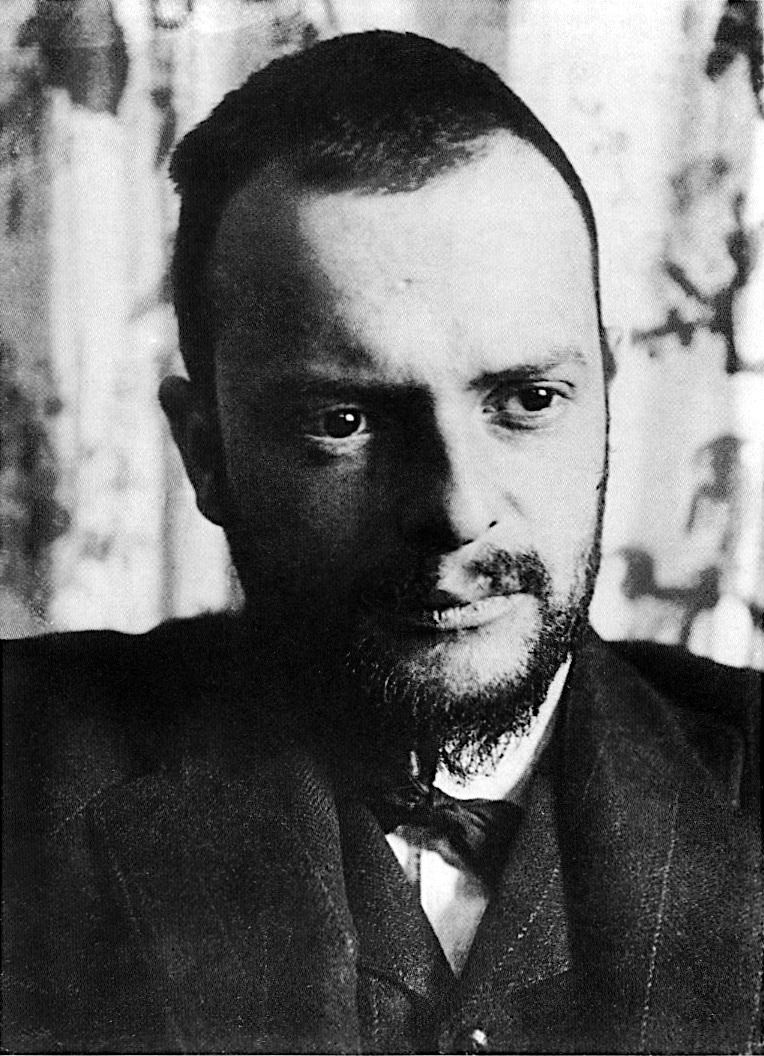
Paul Klee citáty a výroky
Paul Klee: Citáty v angličtine
Quote (1908), # 816, in The Diaries of Paul Klee; University of California Press, 1964; as quoted by Francesco Mazzaferro, in 'The Diaries of Paul Klee - Part Three' : Klee as a Secessionist and a Neo-Impressionist Artist http://letteraturaartistica.blogspot.nl/2015/05/paul-klee-ev.html <br class="br">1903 - 1910
“Nature can afford to be prodigal in everything, the artist must be frugal down to the last detail.”
Diary entry (Munich, 1909), # 857, in The Diaries of Paul Klee, 1898-1918; University of California Press, 1968, p. 236
1903 - 1910
Kontext: Nature can afford to be prodigal in everything, the artist must be frugal down to the last detail.
Nature is garrulous to the point of confusion, let the artist be truly taciturn.
“The main thing now is not to paint precociously but to be, or at least become, an individual.”
Diary entry (3 June 1902), # 411, in The Diaries of Paul Klee, 1898-1918; University of California Press, 1968
1895 - 1902
Kontext: The main thing now is not to paint precociously but to be, or at least become, an individual. The art of mastering life is the prerequisite for all further forms of expression, whether they are paintings, sculptures, tragedies, or musical compositions.
Diary entry (Munich, 1901), # 136, in The Diaries of Paul Klee, 1898-1918; University of California Press, 1968, p. 48
1895 - 1902
Section V
1916 - 1920, Creative Credo (1920)
Kontext: Formerly we used to represent things visible on earth, things we either liked to look at or would have liked to see. Today we reveal the reality that is behind visible things, thus expressing the belief that the visible world is merely an isolated case in relation to the universe and that there are many more other, latent realities. Things appear to assume a broader and more diversified meaning, often seemingly contradicting the rational experience of yesterday. There is a striving to emphasize the essential character of the accidental.
“Art does not reproduce what we see. It makes us see.”
Section I
(de) Kunst gibt nicht das Sichtbare wieder, sondern macht sichtbar.
1916 - 1920, Creative Credo (1920)
Varianta: Art does not reproduce the visible; rather, it makes visible.
Diary entry (1913), # 944; as quoted by Francesco Mazzaferro, in 'The Diaries of Paul Klee - Part Four', : Klee as an Expressionist and Constructivist Painter http://letteraturaartistica.blogspot.nl/2015/05/paul-klee-ev27.html <br class="br">1911 - 1914
Quote (1908), # 831, in The Diaries of Paul Klee; University of California Press, 1964; as quoted by Francesco Mazzaferro, in 'The Diaries of Paul Klee - Part Three' : Klee as a Secessionist and a Neo-Impressionist Artist http://letteraturaartistica.blogspot.nl/2015/05/paul-klee-ev.html <br class="br">1903 - 1910
“The eye travels along the paths cut out for it in the work.”
I.13 Productive | Receptive, p. 33
1921 - 1930, Pedagogical Sketch Book, (1925)
Quote (1916), # 1008, in The Diaries of Paul Klee, translation: Pierre B. Schneider, R. Y. Zachary and Max Knight; publisher, University of California Press, 1964
1916 - 1920
Quote (June 1902), as cited in Artists on Art, from the 14th – 20th centuries, ed. Robert Goldwater and Marco Treves; Pantheon Books, 1972, London, p. 443
1895 - 1902
quote of Paul Klee from the text Exact experiments in the realm of art, 1928; as quoted in 'Klee & Kandinsky', 2015 exhibition text, Lenbachhaus und Kunstbau Munich, 2015-2016 https://www.zpk.org/en/exhibitions/review_0/2015/klee-kandinsky-969.html <br class="br">1921 - 1930
Klee's statement written in 1923, in 'Paths of the Study of Natura' (Wage dar Natur studiums), Paul Klee; in Yearbook of the Staatlich. Bauhaus, Weimar, 1919-1923, Bauhaus Verlag, Weimar, 1923
1921 - 1930
Quote (1904), # 536, in The Diaries of Paul Klee, translation: Pierre B. Schneider, R. Y. Zachary and Max Knight; publisher, University of California Press, 1964
1903 - 1910
Paul Klee, in an autobiographical text for Wilhelm Hausenstein, 1919; as quoted in 'Klee & Kandinsky', 2015 exhibition text, Lenbachhaus und Kunstbau Munich, 2015-2016 https://www.zpk.org/en/exhibitions/review_0/2015/klee-kandinsky-969.html <br class="br">1916 - 1920
Quote (December 1903), as cited in Artists on Art, from the 14th – 20th centuries, ed. Robert Goldwater and Marco Treves; Pantheon Books, 1972, London, p. 444
1903 - 1910
Quote (1903), # 485, in The Diaries of Paul Klee, translation: Pierre B. Schneider, R. Y. Zachary and Max Knight; publisher, University of California Press, 1964
1903 - 1910
Diary entry (1915), # 951 , in The Diaries of Paul Klee, translation: Pierre B. Schneider, R. Y. Zachary and Max Knight; publisher, University of California Press, 1964 <br class="br">1916 - 1920 <br class="br">Varianta: The more horrifying this world becomes (as it is these days) the more art becomes abstract; while a world at peace produces realistic art. <br class="br">Varianta: The more horrifying this world becomes, the more art becomes abstract; while a world at peace produces realistic art. (this variant was quoted in the speech "Between Two Ages: The Meaning Of Our Times" by Wm. Van Dusen Wishard) http://www.commonwealthnorth.org/transcripts/wishard.html
Quote (1912), # 931, in The Diaries of Paul Klee, translation: Pierre B. Schneider, R. Y. Zachary and Max Knight; publisher, University of California Press, 1964
1911 - 1914
Quote (1911), Diary # 873; as cited by Francesco Mazzaferro, in 'The Diaries of Paul Klee Part Four', : Klee as an Expressionist and Constructivist Painter http://letteraturaartistica.blogspot.nl/2015/05/paul-klee-ev27.html <br class="br">1911 - 1914
Quote (early 1911), Diary # 888; as cited by Francesco Mazzaferro, in 'The Diaries of Paul Klee Part Four', : Klee as an Expressionist and Constructivist Painter http://letteraturaartistica.blogspot.nl/2015/05/paul-klee-ev27.html <br class="br">Alfred Kubin understood Klee's hieroglyphic language, based on symbols and signs and bought a series of works. As a reaction Klee started in February 1911 to make a precise catalog of all the works, still in his possession <br class="br">1911 - 1914
I.13 Productive | Receptive, p. 33
1921 - 1930, Pedagogical Sketch Book, (1925)
1921 - 1930
Zdroj: 'Bauhaus prospectus 1929'; as quoted in Artists on Art, from the 14th – 20th centuries, ed. by Robert Goldwater and Marco Treves; Pantheon Books, 1972, London, p. 444
Quote from Diaries III, 1911; as quoted by Enric Jardi, Paul Klee, Rizzoli Intl Pubns, 1991 - ISBN 0-8478-1343-6, p 12
In Autumn 1911 Klee made an acquaintance with August Macke and Kandinsky, and in winter he joined the editorial team of the almanac Der Blaue Reiter. After meeting Kandinsky in Munch, Klee recorded this.
1911 - 1914
1921 - 1930
Zdroj: 'Bauhaus prospectus 1929'; as quoted in Artists on Art, from the 14th – 20th centuries, ed. by Robert Goldwater and Marco Treves; Pantheon Books, 1972, London, p. 444
Quote (July 1917), # 1081, in The Diaries of Paul Klee, translation: Pierre B. Schneider, R. Y. Zachary and Max Knight; publisher, University of California Press, 1964
1916 - 1920
Quote (1911), Diary # 875; as cited by Francesco Mazzaferro, in 'The Diaries of Paul Klee Part Four', : Klee as an Expressionist and Constructivist Painter http://letteraturaartistica.blogspot.nl/2015/05/paul-klee-ev27.htmlparagraph <br class="br">1911 - 1914


