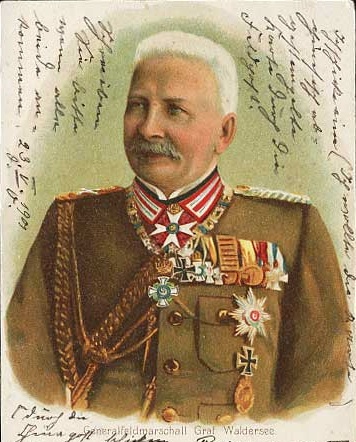
Alfred von Waldersee citáty
page 2

Alfred Ludwig Heinrich Karl Graf von Waldersee was a German field marshal who became Chief of the Imperial German General Staff.

Born into a prominent military family, von Waldersee saw distinguished service as an artillery officer, and became Prussian military attaché at the Paris embassy in 1870. This gave him insight into the French defences that would prove crucial in the upcoming Franco-Prussian War, in which he played a significant role. Later, as principal assistant to Field-Marshal Helmuth von Moltke the Elder, Chief of the Imperial General Staff, von Waldersee gained influence with the future Kaiser Wilhelm II, who promoted him Chief of Staff on his accession.

When the Peking legation compound was besieged by the Boxer insurgents in 1900, von Waldersee was appointed as head of an 8-nation relief force. Although he arrived too late to take part in the fighting, he conducted punitive expeditions which succeeded in pacifying the Boxers. Wikipedia  

✵ 8. apríl 1832 – 5. marec 1904
Alfred von Waldersee fotka
Alfred von Waldersee: 37   citátov 0   Páči sa

Alfred von Waldersee: Citáty v angličtine

“"Democrat" is among officers simply a term denoting a bad lot.”

Waldersee in his diary, quoted in Walter Görlitz, History of the German General Staff, 1657-1945 https://ia801907.us.archive.org/34/items/in.ernet.dli.2015.285159/2015.285159.The-_text.pdf

“How I despise the liberal gang that has captured the Chamber! They are prisoners of their own verbose unrealism, and are setting the country back further from year to year.”

Waldersee in his diary, quoted in Walter Görlitz, History of the German General Staff, 1657-1945 https://ia801907.us.archive.org/34/items/in.ernet.dli.2015.285159/2015.285159.The-_text.pdf

“A good many men will be killed, however, as long as no man can prove to me that a man can die more than once, I am not inclined to regard death for the individual as a misfortune.”

Waldersee in November, 1877, as quoted by Gordon Alexander Craig, "Germany, 1866-1945" (Oxford University Press, 1978) p.133